
If a patient searches for your clinic online and sees two reviews — or none at all — they will likely move on to the next name on the list. Online reputation management for healthcare is no longer optional. It is one of the most powerful drivers of patient trust, discovery, and booking decisions in the Philippines today.
This guide walks you through the ethical, practical strategies that clinic owners and healthcare professionals can use right now: how to ask for reviews without crossing any lines, how to respond to every type of feedback, and how to build a system that consistently generates a steady stream of 5-star ratings.…this is why online reputation management for healthcare has become a non-negotiable part of running a modern clinic.
Why Patient Reviews Are the New Word-of-Mouth
Understanding online reputation management for healthcare starts with how patients search for providers today. Before online reviews existed, patients found their doctors through family referrals or neighborhood recommendations. That word-of-mouth still exists — but today it happens on Google, Facebook, and Zocdoc, and it is visible to hundreds of people at once.
Research consistently shows that the vast majority of patients read online reviews before choosing a healthcare provider. A single negative review left unaddressed can undermine years of excellent clinical work, while a steady stream of positive, authentic testimonials builds a reputation that no paid ad can replicate.
For Philippine healthcare professionals — whether you run a family clinic, a dental practice, a dermatology center, or a wellness studio — online reviews are now a core part of how patients evaluate whether to trust you before they even walk through your door.
The Ethics of Asking for Reviews
Effective online reputation management for healthcare is built on trust — which means the way you collect reviews matters as much as the reviews themselves. There is a right way and a wrong way to ask patients for reviews. Before anything else, let us be clear about what is off-limits:
- Offering incentives in exchange for reviews (discounts, freebies, free consultations). This violates Google’s policies and erodes trust.
- Writing reviews on behalf of patients, or asking staff to do so. This is fabrication.
- Selectively asking only patients you know will say something positive. Skewed samples mislead future patients.
- Flooding your profile with reviews all at once. Sudden spikes look suspicious and may trigger platform filters.
What is completely ethical — and highly effective — is making it easy for genuinely satisfied patients to share their experience. Most patients who had a great visit would happily leave a review; they either never think to do it or don’t know how. Your job is to remove that friction.
When to Ask: The Right Moment Makes All the Difference
Timing your review request correctly is one of the most underrated strategies in healthcare online reputation management. Ask too early, and the patient is still processing their visit. Ask too late and the emotional high has faded.
Best Times to Ask
- Immediately after a successful consultation or procedure — when the patient is still feeling cared for
- At checkout — a short verbal mention from your front desk staff pairs well with a follow-up message
- In a post-visit follow-up message sent 24–48 hours after the appointment
- After a patient mentions unprompted that they had a great experience
Moments to Avoid
- Immediately after delivering a difficult diagnosis or treatment plan
- When a patient is visibly stressed, in a hurry, or in pain
- During the visit itself, it feels transactional and premature
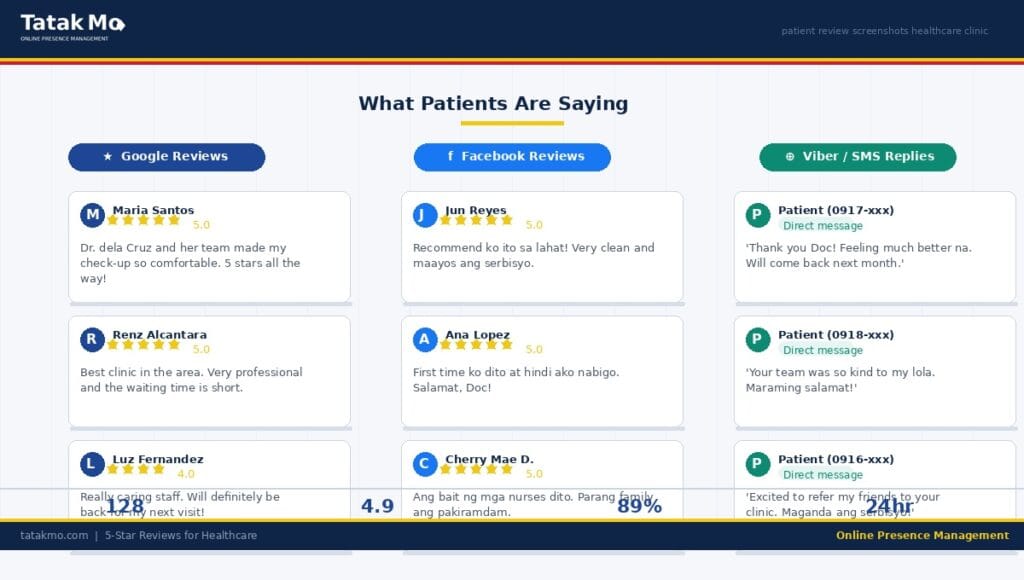
Email Templates for Review Requests (Copy and Customize)
These templates are designed to feel personal, not automated. Personalize the patient’s name and your clinic name before sending.
Template 1: Post-Visit Email (24–48 Hours After Appointment)
✉️ REVIEW REQUEST EMAIL — Post-Visit (24–48 hrs) Subject: How was your visit, [Patient First Name]?
Hi [Patient First Name],
Thank you for trusting us with your care during your visit on [Date]. We hope you are feeling well.
If you have a moment, we would love to hear about your experience at [Clinic Name]. Patient feedback helps us continue improving, and it also helps other patients in our community find the care they need.
Sharing your experience takes less than 2 minutes: → [Direct Google Review Link]
Thank you again for choosing [Clinic Name]. We look forward to seeing you at your next visit.
Warm regards, [Your Name] [Clinic Name] | [Contact Number] |
Template 2: SMS or Viber Message (Short Format)
💬 REVIEW REQUEST SMS / VIBER — Short Format
Hi [First Name]! Thank you for visiting [Clinic Name]. If you had a great experience, a quick Google review means the world to us and helps other patients find trusted care. Here’s the link: [Short Link]. Thank you! 😊
Template 3: In-Clinic Card
A printed QR code card handed at checkout is often the most effective review request of all — it meets patients at the moment when gratitude is highest.
🖨️ IN-CLINIC QR CARD — Front Desk Handout
Front: “Did we take good care of you today?”
Subtext: Share your experience and help other patients in [City] find trusted healthcare.
QR Code: → Links directly to Google review page
Back: Clinic logo, contact details, next appointment reminder
How to Respond to Every Type of Review
Responding to reviews — positive and negative — is a non-negotiable part of online reputation management for healthcare. Your responses are not just for the reviewer; they are for every potential patient reading your profile. A thoughtful, professional reply signals that you are attentive, accountable, and worthy of trust.
Responding to 5-Star Reviews
Never leave a positive review with a blank response. Even a brief acknowledgment shows that real people work at your clinic and that you genuinely care.
⭐ RESPONSE FRAMEWORK — 5-Star Reviews
Pattern: Thank by name → Acknowledge the specific detail they mentioned → Reinforce your commitment → Invite them back
Example:
“Thank you so much, [Name]! We’re really glad our team made your [procedure/visit] comfortable. Your kind words mean a lot to everyone here at [Clinic Name]. We look forward to taking care of you again soon!”
Responding to Neutral 3–4 Star Reviews
These are golden opportunities. A patient who gave 4 stars liked you but held something back. Your response can win them back completely.
🔄 RESPONSE FRAMEWORK — Neutral Reviews (3–4 Stars)
Pattern: Thank sincerely → Acknowledge where you fell short → Share what you’re doing about it → Invite direct feedback offline
Example:
“Thank you for taking the time to share this, [Name]. We’re glad parts of your visit went well, and we hear your concern about [waiting time / communication / facility]. We are working on improving this and would love to make it right. Please feel free to reach us at [contact] so we can follow up personally.”
Responding to Negative Reviews
This is where most clinics lose control of their narrative — by either ignoring negative reviews or responding defensively. Neither approach helps. A composed, empathetic response protects your reputation far more effectively than a rebuttal.
Important: Never include patient-identifiable information in your response, even if the review contains inaccuracies. Maintain patient confidentiality at all times.
🛡️ RESPONSE FRAMEWORK — Negative Reviews (1–2 Stars) Pattern: Acknowledge their experience → Express genuine concern → Do NOT argue publicly → Invite offline resolution
Example: “We’re sorry to hear that your experience didn’t meet your expectations, [Name]. Patient care is our top priority, and we take all feedback seriously. We would appreciate the opportunity to address your concern directly. Please reach out to us at [email or phone] so we can look into this and make things right. Thank you for letting us know.” |
Platforms That Matter Most for Healthcare Reputation in the Philippines
Not all review platforms are equally important. For Philippine healthcare professionals, focus your energy on these three:
1. Google Business Profile
Google reviews are the single most important factor for local search visibility. When patients search “dentist near me” or “OB-GYN in [City],” Google Business Profile ratings appear front and center. Aim for at least 20 verified reviews to build credibility and a 4.5+ star average. This is the single most visible channel for online reputation management for healthcare in local search.
2. Facebook
In the Philippines, Facebook is often where patients go first for healthcare recommendations — especially in community groups and local pages. Enable Facebook Reviews on your Business Page and monitor it weekly.
3. Doctorlink / Referral Platforms
Niche healthcare directories and telemedicine platforms increasingly display patient ratings. Claim and complete your profiles on any platform where your specialty has active patient activity.
What to Do About Negative Reviews (Beyond Responding)
Responding well is step one. But sustainable online reputation management for healthcare also means addressing the underlying issues that generate negative feedback in the first place.
- Long wait times: Implement a digital queue system or send SMS reminders when appointments are running late
- Communication gaps: Train front-desk staff on warm handoffs and clear post-consultation summaries
- Billing confusion: Provide itemized receipts and explain procedures before rendering them
- Facility cleanliness: Conduct monthly patient experience audits
Flagging a review for removal is possible — but only when it violates platform guidelines (spam, offensive language, irrelevance). Never attempt to game this process for legitimate critical feedback.
Building a Long-Term Review Strategy
The clinics that consistently rank highest in local search aren’t generating reviews in bursts — they have built review collection into their standard patient journey. Here’s how to systematize it:
Step 1 — Designate a Review Owner
Assign one front-desk team member to own the review process. This person monitors incoming reviews, sends follow-up messages, and flags issues that need a manager response.
Step 2 — Set a Monthly Review Goal
Aim for at least 4–6 new reviews per month per clinic location. Track this the same way you track appointment volume.
Step 3 — Shorten the Path to the Review Page
Create a short custom link to your Google review form (available in Google Business Profile dashboard) and use it in all communications. Every click removed from the process increases completion rates.
Step 4 — Celebrate Reviews with Your Team
When your team sees their specific efforts mentioned by name in a review, it motivates continued excellence. Share positive reviews in your staff group chat. Acknowledge the team members called out.
Step 5 — Audit Quarterly
Every quarter, review your average star rating, total review count, and response rate. Use the data to adjust your request timing, channels, and messaging.
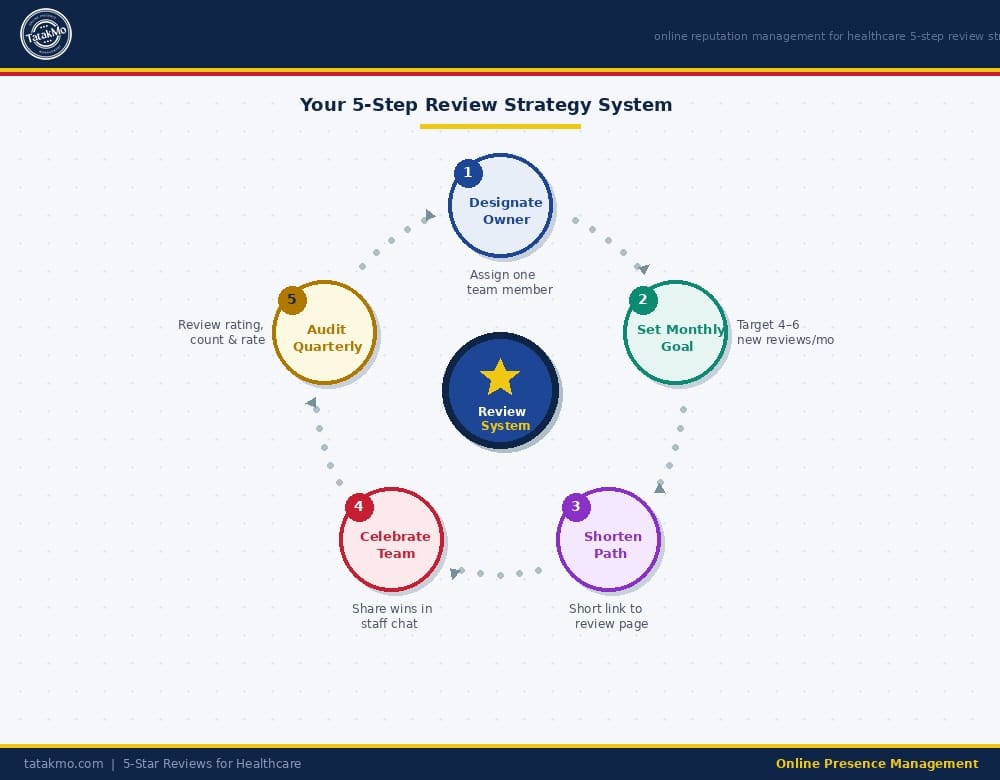
Building a reliable system for online reputation management for healthcare takes consistency — but the steps above give you everything you need to start this week.
📩 GET WEEKLY HEALTHCARE MARKETING TIPS Subscribe to the Tatak Mo newsletter and receive practical strategies for growing your clinic’s online presence — every week, straight to your inbox.