Introduction
A trustworthy professional profile plays a critical role in determining whether people respond to messages, review proposals, schedule meetings, or disengage without explanation. In contemporary digital environments, profiles have effectively replaced many traditional trust-building mechanisms such as face-to-face introductions, referrals, reputation by proximity, and in-person meetings. What once required repeated interaction over time now occurs almost instantly, often within seconds of a profile being viewed. Before a meeting is scheduled, before a proposal is examined in detail, and before a question is formally raised, individuals typically evaluate one primary source of information: the professional profile—often quietly and well before any visible interaction takes place.
This behavior is not driven by curiosity alone, but by risk awareness. Digital interactions introduce uncertainty because they lack physical cues, shared social context, and immediate accountability. As a result, individuals instinctively attempt to minimize that uncertainty as efficiently as possible. Professional profiles therefore function less as promotional tools and more as evaluative filters that help people decide whether engagement feels safe, worthwhile, or necessary.
In practice, viewers are subconsciously assessing several questions:
- Is this individual authentic and credible, or are they presenting a constructed persona?
- Do they possess the competence and experience they claim to have?
- Can they be trusted with time, financial resources, sensitive information, or professional responsibility?
This article examines the structural and communicative elements that contribute to a trustworthy professional profile. Rather than relying on motivational rhetoric, aesthetic trends, or personal
branding conventions, the discussion focuses on observable, research-aligned principles that influence credibility, perception, and decision-making in digital contexts.
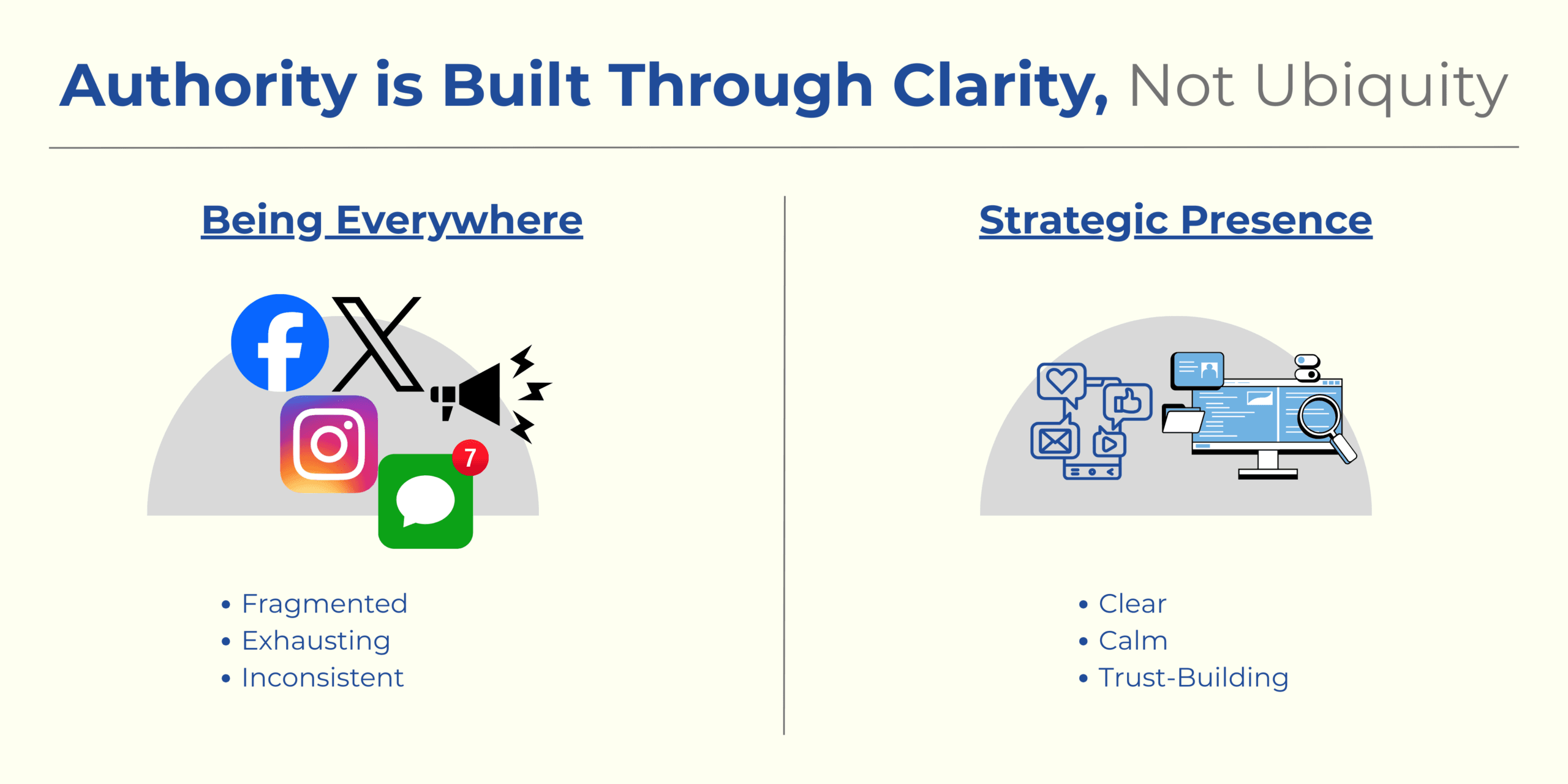
This is not an argument for increased visibility, aggressive self-promotion, or constant content production. Instead, it is an exploration of how trust can be intentionally designed through clarity, coherence, and consistency across time.
Why Trust Functions as a Core Digital Asset
In practical terms, this trust evaluation occurs in familiar, high-stakes scenarios: a hiring manager reviewing a candidate’s LinkedIn profile before scheduling an interview; a business owner assessing a consultant’s website before requesting a proposal; or a patient examining a healthcare professional’s profile before booking an appointment. In each case, the profile becomes a stand-in for reputation, experience, and intent long before direct contact is made.
In traditional professional settings, trust developed through repeated physical proximity and social interaction. Offices, conferences, academic institutions, faith communities, and shared workplaces created opportunities for familiarity, which in turn fostered confidence and accountability. Reputation was reinforced through observation, shared experiences, and social verification.
In contrast, many modern professional relationships originate and remain entirely within digital spaces. Individuals may collaborate, hire, consult, or transact without ever meeting in person. In these environments, trust must be inferred from limited signals rather than accumulated through prolonged exposure.
As a result, professional profiles now serve multiple evaluative functions simultaneously:
- An initial point of introduction that replaces in-person meetings
- A credibility assessment mechanism that substitutes for referrals
- A perceived risk indicator that informs engagement decisions
Individuals rarely articulate the question of trust explicitly. Instead, they conduct rapid cognitive assessments for ambiguity, inconsistency, exaggeration, and potential warning signs. When uncertainty increases, engagement typically decreases or stops entirely.
The absence of trust rarely results in direct rejection or negative feedback. More often, it results in non-response, delayed replies, or disengagement without explanation.
This phenomenon explains why many technically skilled or experienced professionals experience limited engagement despite demonstrable competence. In such cases, the underlying issue is not ability, but the way trust signals are structured, communicated, and maintained through the professional profile.

Defining a Trustworthy Professional Profile
Because professional profiles function as tools for minimizing perceived risk, their effectiveness depends less on self-promotion and more on how clearly they reduce uncertainty for the viewer.
A trustworthy professional profile should not be confused with a curated highlight reel, a static résumé uploaded online, or a collection of aspirational statements and credentials. These approaches often prioritize self-presentation over clarity and can unintentionally increase skepticism.
Instead, a trustworthy professional profile operates as a structured narrative designed to reduce uncertainty at each stage of evaluation. It guides the viewer toward understanding who the professional is, how they operate, and what engaging with them is likely to feel like.
At minimum, a trustworthy professional profile should provide clear answers to three foundational questions:
- Who is this person in professional terms, and how should they be categorized?
- What specific problems do they address, and for whom?
- What evidence supports their credibility and judgment?
When any of these questions remain unanswered or unclear, trust diminishes regardless of actual competence. Importantly, trust is not established through assertion or self-description, but through inference derived from consistent and coherent signals.
Section 1: Identity Clarity as the Basis of Trust
The initial layer of trust is identity clarity. This refers to how quickly and accurately a viewer can understand an individual’s professional role, scope of expertise, and primary value proposition.
Ambiguity undermines trust. Profiles that attempt to encompass multiple unrelated identities often signal a lack of focus or direction rather than versatility. When viewers cannot easily categorize a professional, they experience cognitive friction, which often leads to hesitation or disengagement.
Effective identity clarity involves:
- A clearly defined primary role that anchors the profile
- A coherent professional focus that aligns experience and messaging
- Consistent representation across platforms and contexts
This does not require limiting one’s capabilities to a single function. Rather, it requires leading with a clearly articulated core role and positioning additional skills as supporting elements rather than competing identities.
Common indicators of unclear identity include:
- Multiple unrelated job titles presented without hierarchy or explanation
- Broad descriptors that lack contextual definition
- Inconsistent professional narratives across platforms
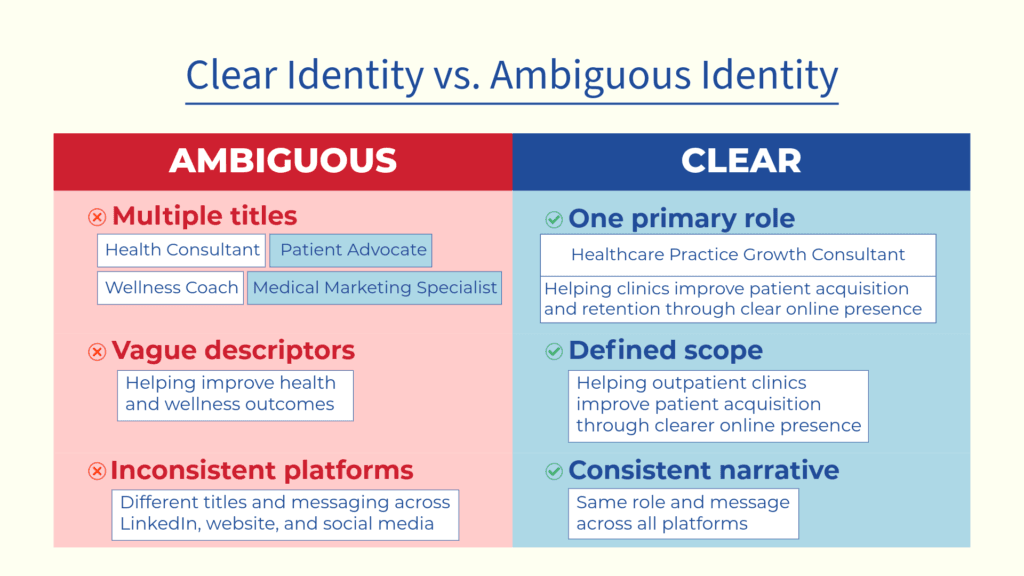
Clear identity reduces cognitive effort for the viewer, which in turn increases perceived reliability and professionalism.
Section 2: Visual Consistency and Credibility Signals
Visual elements are a fundamental component of professional communication. Design choices influence perception before any textual engagement occurs, often shaping initial impressions subconsciously.
A trustworthy professional profile demonstrates visual coherence and intentionality. This includes consistency in imagery, typography, color usage, layout, and overall presentation style.
Key visual indicators of trust include:
- A professional, current, and context-appropriate profile photograph
- Uniform visual styling across platforms and materials
- Readable layouts with appropriate spacing and hierarchy
- Visual elements that accurately reflect present professional status
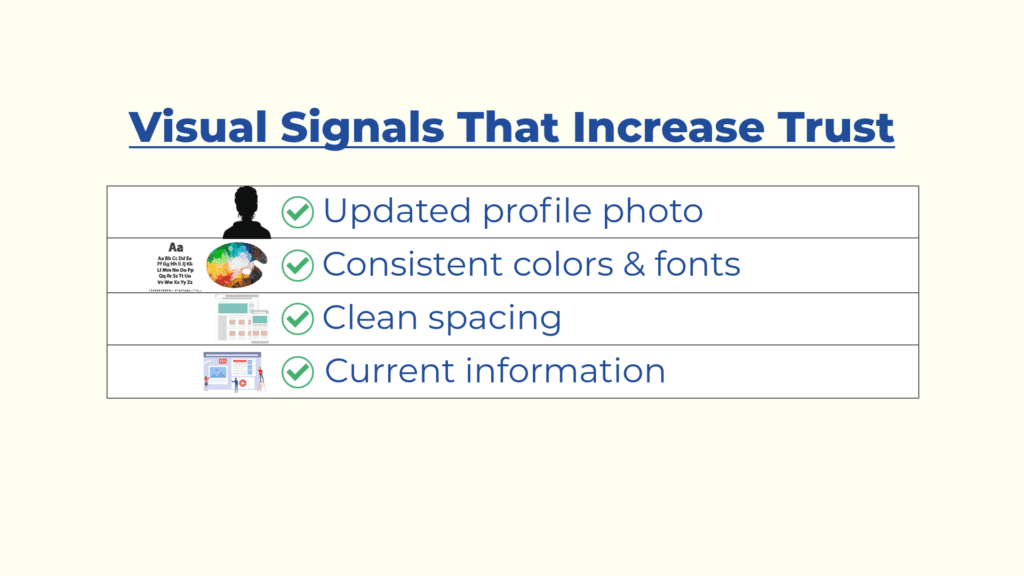
Inconsistencies, outdated visuals, or excessive stylization can unintentionally signal neglect, instability, or misalignment. Visual maintenance communicates attentiveness and care, both of which contribute to perceived dependability and seriousness.
Section 3: Language as a Tool for Reducing Uncertainty
Language plays a central role in shaping trust. Overstated claims tend to provoke skepticism, while vague descriptions create confusion and ambiguity.
For example, a statement such as “I help businesses grow and succeed” offers little information that a reader can meaningfully evaluate. In contrast, a statement like “I help small healthcare clinics improve patient acquisition by clarifying their online presence” defines scope, audience, and function, making the claim easier to assess and trust.

A trustworthy professional profile employs precise, measured language that reflects competence without exaggeration. The goal is not persuasion, but clarity.
Trust-supportive language tends to be:
- Specific rather than expansive or inflated
- Evidence-oriented rather than aspirational
- Oriented toward the audience’s needs rather than self-promotion
Statements that define a narrow and well-articulated scope of expertise often appear more credible than broad, undefined claims. Specificity allows readers to more easily assess relevance, fit, and reliability.
Section 4: Demonstrating Credibility Through Evidence
Assertions alone invite scrutiny. Evidence supports belief.
A trustworthy professional profile incorporates supporting material such as:
- Case analyses or summarized experiences
- Descriptions of professional processes and methodologies
- Reflective insights on decision-making and problem-solving
- Contextualized outcomes or lessons learned
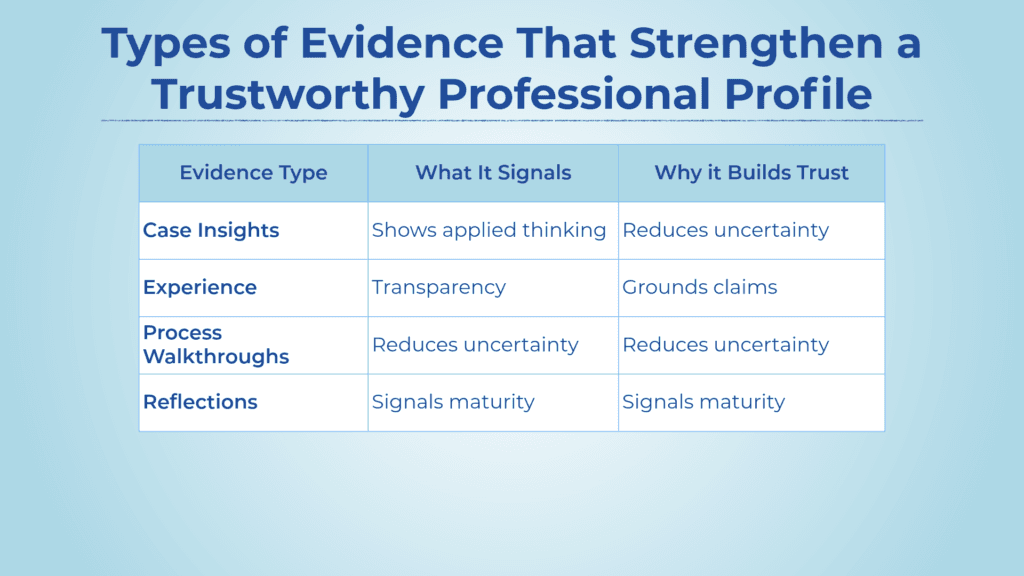
Evidence does not require disclosure of confidential data or named clients. Even generalized examples and transparent explanations of methodology can significantly enhance credibility.
Providing insight into how decisions are made and how challenges are approached contributes to perceived competence, judgment, and integrity.
Section 5: Consistency Over Time
Trust develops through repeated exposure to consistent signals. Professional profiles are often encountered multiple times before engagement occurs, sometimes across different platforms or contexts.
Consistency reassures viewers that the professional identity presented is stable and reliable. In contrast, abrupt changes in messaging, focus, tone, or positioning may raise concerns regarding long-term dependability.
A trustworthy professional profile evolves gradually and intentionally. Adaptation and growth are expected; volatility and frequent repositioning are not.
Section 6: Professional Presence Without Excessive Output
A common misconception in digital spaces is that frequent visibility automatically increases trust. In practice, indiscriminate content production can dilute perceived authority and create confusion.
A trustworthy professional profile reflects intentional presence rather than constant output. This includes:
- Selective and purposeful communication
- Emphasis on insight, relevance, and coherence
- Willingness to remain silent when no substantive contribution is available
Consistency should be understood as thematic and conceptual coherence rather than posting frequency.
Section 7: Alignment Between Values and Conduct
Trust deteriorates when there is a discrepancy between stated values and observable behavior.
Professional claims regarding service, integrity, reliability, or expertise must be reinforced through corresponding communication style, responsiveness, and interaction quality. Misalignment between messaging and behavior often produces implicit distrust.
A trustworthy professional profile demonstrates alignment across:
- Expressed values and tone
- Stated commitments and follow-through
- Professional messaging and lived experience
Such alignment strengthens credibility even when outcomes are still developing or evolving.
Section 8: Structuring Authority Rather Than Asserting It
Authority is more effectively established through demonstrated judgment than through declarative claims. Credentials and experience gain significance when integrated into a coherent professional narrative.
A trustworthy professional profile contextualizes authority by:
- Explaining lessons derived from experience
- Articulating decision-making frameworks
- Demonstrating reflective and ethical judgment
This approach positions authority as a byproduct of competence and consistency rather than a self-proclaimed status.
Section 9: Emotional Predictability and Professional Tone
Trust involves both cognitive and emotional components. Individuals seek assurance that professional interactions will be respectful, predictable, and psychologically safe.
Tone significantly influences this perception. Profiles that avoid aggressive persuasion, defensiveness, or ambiguity tend to appear more reliable and composed.
Calm, measured communication signals confidence and competence, contributing to a sense of professional safety and predictability.
Section 10: Implicit Evaluation by Profile Viewers
Every profile viewer conducts an implicit evaluation process, often without conscious awareness. Key considerations include:
- Authenticity of presentation
- Consistency of messaging and positioning
- Perceived safety and reliability of engagement
Behavioral responses such as replies, inquiries, referrals, or scheduled meetings serve as indicators of trust. Conversely, non-response frequently reflects unresolved uncertainty rather than explicit rejection.
Why People Decide Whether to Trust You Before They Reply
Assessing Your Own Trustworthy Professional Profile
Evaluating one’s own profile requires deliberate and objective reflection. Consider the following questions:
- Can a viewer accurately summarize my professional role after a brief review?
- Do visual and written elements convey a consistent and coherent narrative?
- Is there evidence demonstrating how I think, decide, and approach my work?
- Does my profile reduce ambiguity, or does it unintentionally create it?
Trust is not incidental. It is the outcome of deliberate design decisions grounded in clarity, consistency, and alignment.
Conclusion: Establishing Presence Before Promotion
A trustworthy professional profile prioritizes credibility over visibility. Rather than seeking attention, it creates confidence through coherence, restraint, and intentional design.
Across the sections above, three principles consistently emerge. First, trust is built through clarity of identity—viewers must quickly understand who you are, what you do, and where you operate professionally. Second, trust is reinforced through consistency of signals, including language, visuals, tone, and positioning over time. Third, trust is sustained through evidence and alignment, where claims are supported by observable behavior, process transparency, and demonstrated judgment.
In digital environments characterized by information saturation and constant noise, clarity functions as a distinguishing factor. Before increasing output, reach, or engagement efforts, professionals should ensure that their profiles effectively reduce uncertainty and communicate reliability.
Long before individuals respond, inquire, or engage, they have already formed judgments regarding trust.
Presence is built before promotion.
Clarity always comes first.
See how your clinic appears to patients online — and start building digital trust today.
Book Your Free Online Presence Health Check
Your clinic’s online presence shapes how patients perceive your care.
Let’s review your website, social media, and digital visibility —
and identify how you can build stronger patient trust before year-end.
References
- The Neuroscience of Trust
- How People Really Judge You
- The Role of Trust in the Digital Age
- Edelman Trust Barometer
- Minimize Cognitive Load to Maximize Usability
- Mental Models
- Credibility Guidelines
- Why Design Matters to Trust
- Why Specificity Matters in Communication
- Why Ambiguity Undermines Trust
- The Power of Consistency
- Why Trust Is the Foundation of Effective Leadership