
Introduction: The Structural Pressure to Build Authority Online
By the end of this article, you will understand how to construct a focused and defensible online presence that generates higher‑quality inquiries, attracts better‑aligned patients or clients, and materially reduces the cognitive and emotional fatigue associated with omnipresent digital participation. More importantly, you will learn how to architect an online presence that functions as an extension of your professional practice rather than as a competing demand upon it.
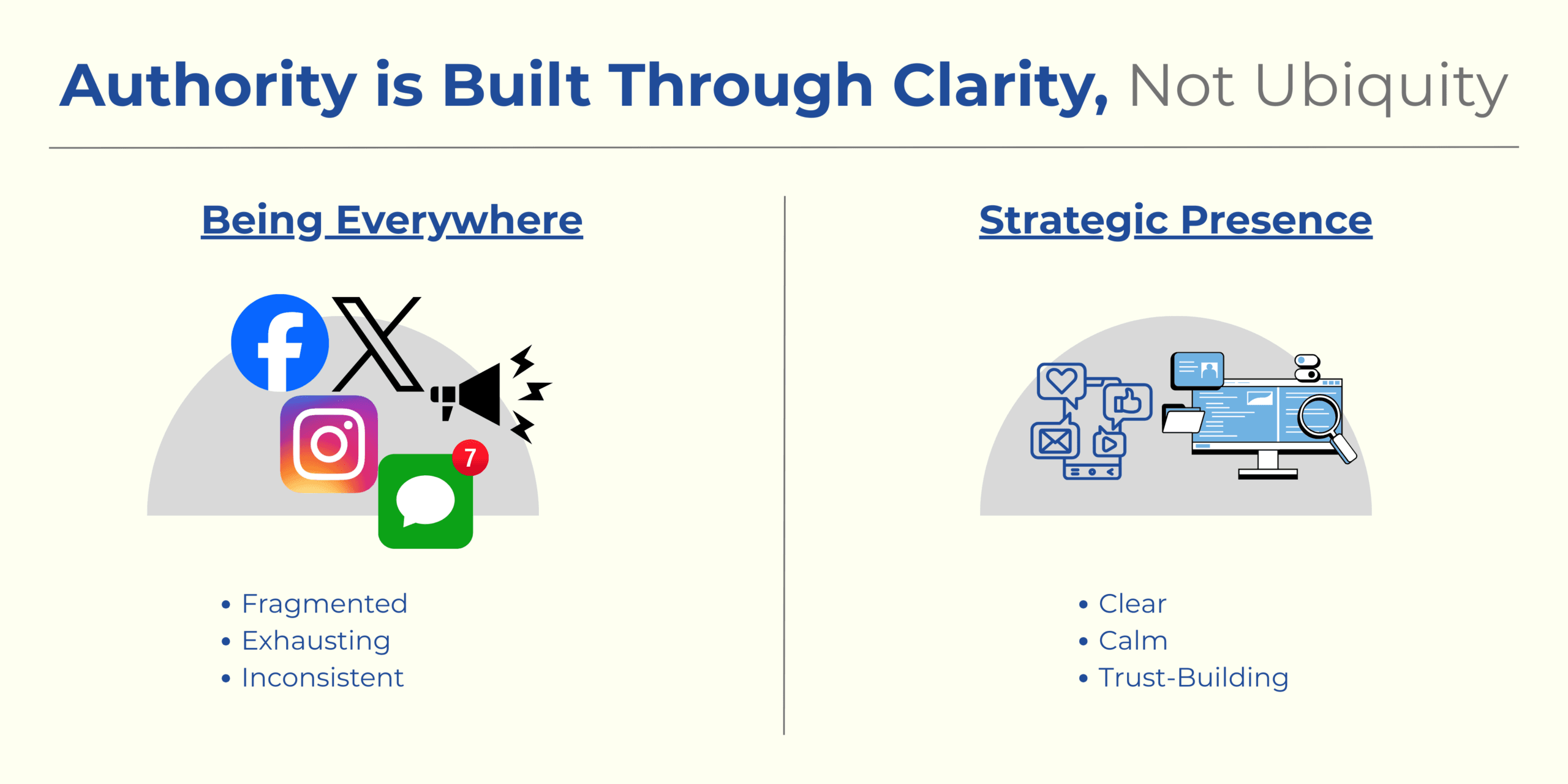
Contemporary professionals operate under a diffuse yet persistent expectation to build authority online through continuous visibility. This expectation is rarely stated outright, but it is reinforced through industry advice, platform incentives, and subtle peer comparison.
You are told—implicitly or explicitly—that authority is a function of frequency: daily posting, constant engagement, perpetual responsiveness, and participation across an ever‑expanding constellation of platforms. Guidance originally developed for influencers, creators, and media‑driven entrepreneurs is routinely transposed onto doctors, therapists, coaches, consultants, and educators whose work is fundamentally trust‑based rather than attention‑based.
For many professionals, this produces a form of strategic dissonance. The behaviors required to satisfy platform logic feel misaligned with the norms, ethics, and rhythms of professional practice. What emerges is not authority, but exhaustion.
Most professionals did not enter their fields to perform visibility. They trained to diagnose, interpret, guide, evaluate, and intervene—often within contexts where precision, restraint, and responsibility matter more than reach. Yet the digital reality is unavoidable. Before a patient schedules a consultation, before a client initiates contact, before a referral becomes actionable, individuals engage in a preliminary act of evaluation.
They search your name. They review your website. They glance at one or two social platforms. Within minutes—often seconds—they decide whether you appear credible, coherent, and safe, or fragmented, ambiguous, and unreliable.
This is where many attempts to build authority online falter.
The prevailing assumption is that authority emerges from ubiquity. In practice, authority is rarely a function of presence alone. It is produced through clarity, consistency, and epistemic trust—delivered in the appropriate contexts, in a coherent sequence, and at a pace that is sustainable for both practitioner and audience.
This article examines how to build authority online without being everywhere. Not through acceleration, spectacle, or noise, but through a deliberately structured and sustainable presence designed for professionals who prioritize depth, ethics, and long‑term credibility.
Why Most Professionals Struggle to Build Authority Online
Understanding the mechanisms by which authority erodes is a prerequisite to reconstructing it within a professional, trust‑based framework.
Many professionals struggle to build authority online because they inadvertently apply influencer‑oriented heuristics to domains in which professional trust operates according to different rules.
Digital platforms reward frequency, novelty, and affective engagement. Algorithmic systems are optimized to maximize time on platform, privileging content that stimulates reaction rather than reflection. Professional authority, by contrast, is built through reliability, conceptual depth, and reassurance. When these two logics intersect without mediation, the result is often strategic incoherence.
Several recurring dynamics account for this breakdown.
Cognitive Overload and Audience Disengagement
When prospective patients or clients encounter divergent messages, tones, or self‑descriptions across multiple platforms, the cognitive burden does not motivate deeper inquiry. Instead, it produces disengagement.
Rather than interpreting inconsistency charitably, audiences experience friction. Uncertainty increases. Trust diminishes.
An overly distributed presence commonly results in:
- Inconsistent explanations of scope, role, or expertise
- Repetitive introductory content without cumulative depth
- Signals of breadth without corresponding indications of mastery
Instead of reinforcing authority online, such conditions generate noise. Noise, in turn, delays decision‑making and amplifies hesitation.
Inconsistency as a Credibility Liability
Authority is not established through maximal expression, but through disciplined repetition.
Professionals who diffuse their presence across platforms frequently modify language, positioning, and emphasis to fit platform norms. Over time, this produces subtle yet consequential inconsistencies in how services, processes, and audiences are described.
In healthcare, wellness, and consulting contexts—where clarity is often equated with safety—such variability undermines credibility.
Professional Trust Versus Influencer Visibility
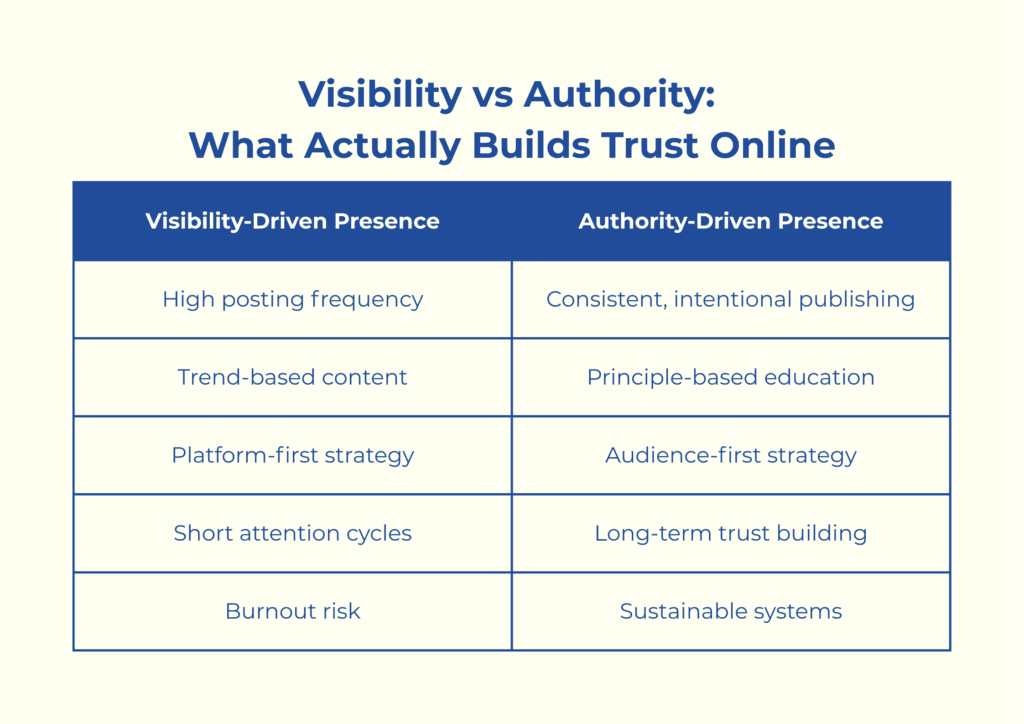
Influencers trade primarily in attention. Professionals trade in trust.
Prospective patients and clients are not seeking entertainment or novelty. They are seeking reassurance: evidence that you understand their situation, can articulate it clearly, and possess the competence and ethical grounding to address it appropriately.
Attempts to be omnipresent frequently force professionals into performative behaviors that erode the very authority they intend to cultivate.
What It Means to Build Authority Online in Contemporary Professional Contexts
Consider two practitioners operating within the same field.
The first publishes infrequently—perhaps once or twice per month. Her website articulates her scope of practice with precision. Conditions treated, decision pathways, consultation processes, and expectations are explicitly described. Her tone is measured and consistent. When prospective patients encounter her digital presence, the experience is coherent. Despite limited activity, trust is established prior to contact.
The second maintains high visibility, posting daily across multiple platforms. Yet his messaging varies substantially. His website lacks specificity. It is unclear which problems he specializes in or which clients he serves best. Despite frequent exposure, uncertainty persists, and inquiries remain tentative.
Both are visible. Only one has authority.
To build authority online in professional contexts is, fundamentally, to reduce uncertainty.
Authority is not synonymous with volume. It is the outcome of epistemic clarity.
For healthcare and professional services, authority manifests when an individual concludes:
“This practitioner understands my problem, can explain it intelligibly, and appears safe to approach.”
Authority Versus Popularity
Popularity is indexed through quantitative metrics: likes, views, followers, and impressions.
Authority is reflected qualitatively through:
- Consultation requests that are specific and informed
- Clients or patients who arrive predisposed to trust
- Referrals that require minimal revalidation
A practitioner with modest visibility but precise positioning will routinely outperform one with extensive exposure but ambiguous framing.
Trust Signals That Support Authority Online
During digital evaluation, audiences implicitly assess several indicators:
- Credentials and experience presented with proportional emphasis
- Explanations that prioritize clarity over persuasion
- Transparency regarding process, scope, and limitations
- Evidence of professional boundaries and ethical orientation
These signals exert greater influence on authority formation than aesthetics, trends, or posting cadence.
Authority and Decision Friction
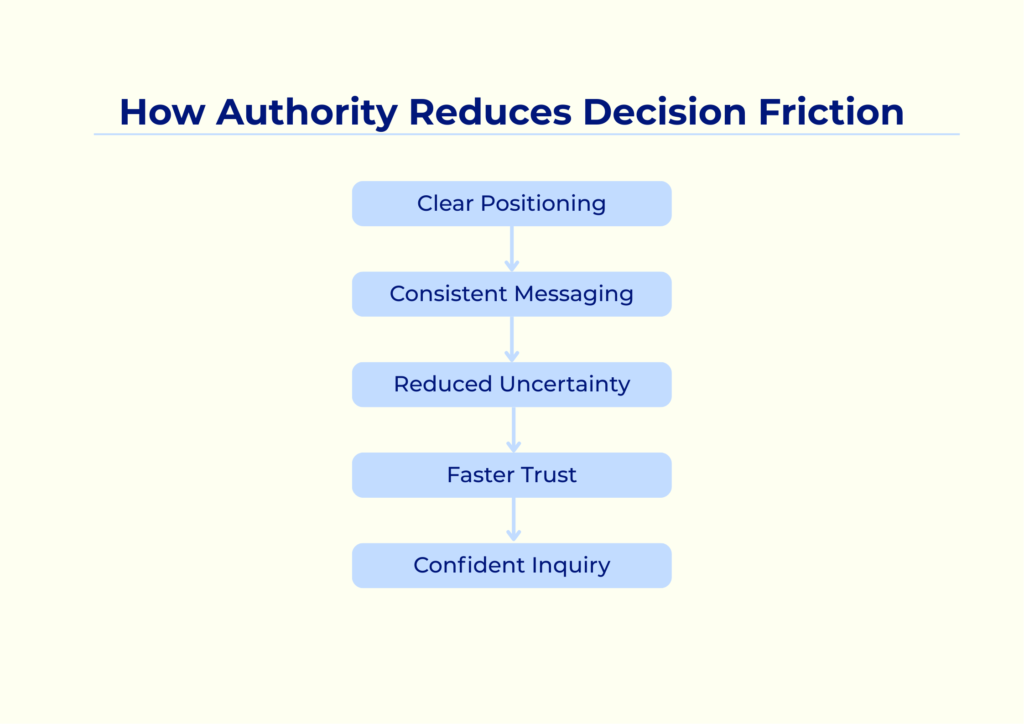
Where authority is established, decisional friction decreases.
Prospective clients and patients do not require extensive internal justification. Uncertainty has been addressed upstream. This is the strategic value of building authority online: it reorganizes decision‑making before direct interaction occurs.
Building Authority Online Through Strategic Positioning
Positioning constitutes the structural foundation of authority.
If an audience cannot readily discern whom you serve, which problems you address, and why your expertise is relevant, no quantity of content will compensate.
Defining Scope and Audience With Precision
Authority emerges through specificity.
Attempts to serve excessively broad audiences necessitate generalized language. Generalization, in turn, signals interchangeability—and interchangeable professionals are rarely the first choice.
Effective positioning requires clarity around:
- Primary audience segments
- Core problems or decision points addressed
- Typical stages of awareness or urgency
Functional Positioning Statements
Concise positioning statements accelerate comprehension:
“We help [defined audience] address [specific problem] through [distinct approach].”
Such statements signal confidence, intentionality, and professional focus.
Boundary Setting as an Authority Signal
Counterintuitively, authority increases when exclusions are articulated.
Clear boundaries communicate discernment and expertise—attributes that are particularly salient in therapeutic, medical, and advisory professions.
The Three Layer Framework for Building Authority Online
Layer 1: The Website as an Epistemic Anchor

Authority is systemic rather than additive.
A well‑designed website establishes conceptual clarity. A focused social platform cultivates familiarity. A substantive authority asset provides depth. When these elements are aligned, they form a reinforcing system.
Social content directs attention toward the website. The website validates social signals. Authority assets demonstrate intellectual and practical competence. The absence of any layer weakens the structure; alignment allows authority to compound over time.
The website functions as a stable reference point—analogous to a clinic or professional office.
It should immediately clarify:
- Professional role and qualifications
- Scope of practice or specialization
- Target audience and exclusions
- Engagement pathways
- Procedural expectations
A coherent website stabilizes authority independent of platform volatility.
Layer 2: Focused Platform Selection
Authority accrues through sustained presence, not dispersion.
Selecting a single platform aligned with audience behavior and professional communication norms enables consistency without overextension.
Layer 3: Authority Assets as Depth Mechanisms
Authority assets externalize professional reasoning.
Long‑form articles, structured discussions, educational series, and conceptual frameworks allow audiences to observe how you think—not merely what you offer. This depth differentiates expertise from promotion.
Content Design for Authority Without Burnout
Authority‑oriented content prioritizes reassurance over stimulation.
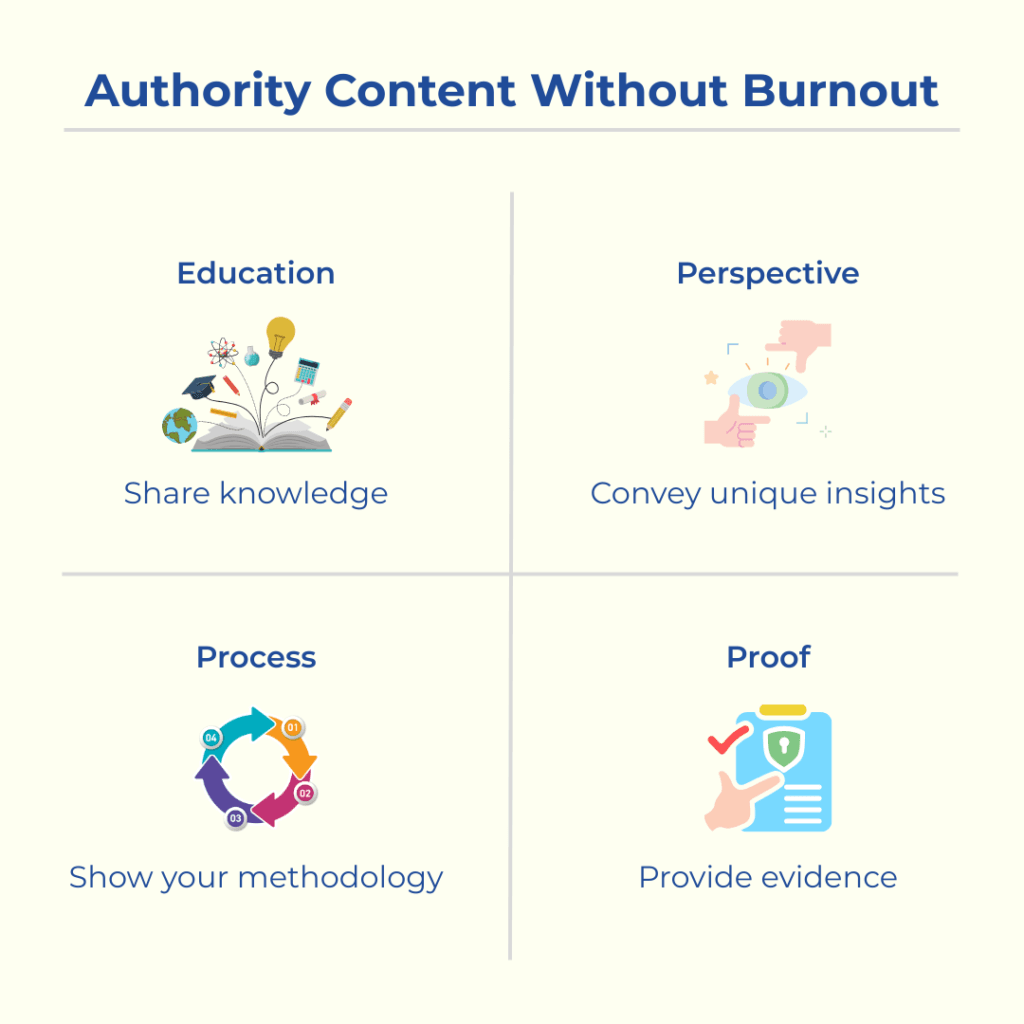
A sustainable content architecture integrates:
- Education: clarifying decisions, risks, and misconceptions
- Perspective: articulating professional judgment
- Process: demystifying engagement and intervention
- Proof: contextualized experience and insight
This structure supports repetition without redundancy.
Consistency as a Structural Advantage
Authority develops incrementally.
Measured, predictable output over extended periods generates greater trust than episodic intensity. Consistency communicates reliability; reliability supports authority.

Structural Errors That Undermine Authority Online
Common failures include:
- Absence of strategic hierarchy
- Obscured credentials or scope
- Ambiguity regarding process or expectations
- Mimicry of influencer aesthetics
Authority strengthens as ambiguity recedes.

See how your clinic appears to patients online — and start building digital trust today.
Book Your Free Online Presence Health Check
Your clinic’s online presence shapes how patients perceive your care.
Let’s review your website, social media, and digital visibility —
and identify how you can build stronger patient trust before year-end.
Tatak Mo’s Approach to Authority Driven Digital Presence
At Tatak Mo, we support healthcare, wellness, and professional service providers in building authority online through intentional design rather than perpetual output.
Our work emphasizes:
- Positional clarity
- Strategic channel selection
- Authority‑centered content systems
- Sustainability aligned with professional practice
This approach serves professionals who value coherence, ethics, and long‑term trust. It is not optimized for trend‑driven growth, viral mechanics, or high‑volume content production.
If you are evaluating whether your current online presence consolidates authority or amplifies noise, this is an appropriate point of inquiry.
References
- Mayer, R. C., Davis, J. H., & Schoorman, F. D. (1995). An Integrative Model of Organizational Trust. Academy of Management Review.
- Edelman Trust Barometer (Annual). Trust and Credibility in Institutions and Professionals.
- Sweller, J. (1988). Cognitive Load During Problem Solving: Effects on Learning. Cognitive Science.
- Susskind, R., & Susskind, D. (2015). The Future of the Professions.
- Simon, H. A. (1971). Designing Organizations for an Information-Rich World.
- McLuhan, M. (1964). Understanding Media: The Extensions of Man.
- General Medical Council (UK). Doctors’ Use of Social Media.
- American Psychological Association (APA). Ethical Principles of Psychologists and Code of Conduct.