If you’re a healthcare professional, you’ve likely spent many years building your qualifications. Medical school, residency training, board certification, fellowships, research, and continuing education all require discipline and commitment. These achievements signal competence, expertise, and dedication to patient care.
Yet many highly trained doctors, therapists, specialists, and wellness practitioners face an unexpected challenge. Despite their qualifications, potential patients often struggle to understand what they actually do or how they can help.
The issue is rarely a lack of skill.
More often, the issue is a lack of clarity.
Today, patients usually search for healthcare providers online before they ever step into a clinic. They browse Google results, read provider profiles, review clinic websites, explore social media, and check patient feedback before deciding whom to trust.
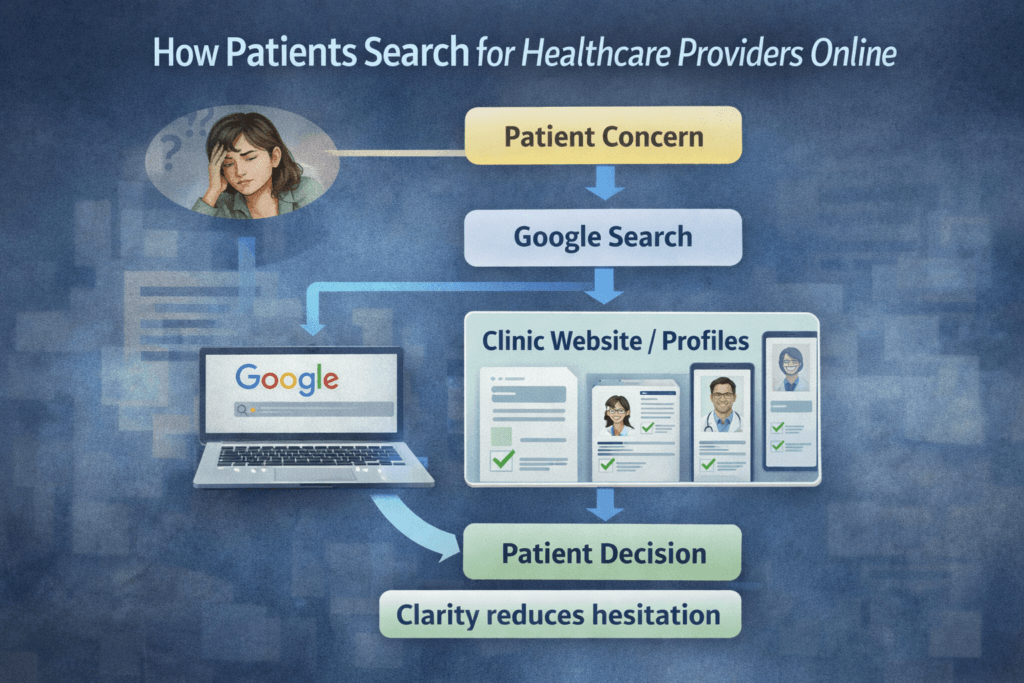
In this environment, clarity for healthcare professionals has become a powerful competitive advantage. Unfortunately, it is also something many professionals overlook.
Some clinicians believe that posting more health tips, sharing educational videos, or producing more social media content will naturally build trust and recognition.
Others assume their credentials will speak for themselves.
In reality, most patients do not spend much time analyzing credentials. Instead, they make quick judgments based on what they immediately understand.
This leads to an important question every healthcare professional should ask:
Is it immediately clear who I help, what problem I solve, and why patients should trust me?
If the answer is unclear, patients hesitate.
And hesitation often leads them to continue searching.
Clarity for healthcare professionals is therefore more than good communication. It is a strategic advantage. It reduces confusion, builds trust faster, and helps patients feel confident choosing a provider.
This article explains why credentials alone are not enough and introduces the 4‑Layer Clarity Model—a simple framework that helps healthcare professionals clearly communicate the problems they solve, the patients they serve, their approach to care, and the authority behind their expertise. Understanding how patients make decisions and structuring your message clearly can significantly strengthen a healthcare professional’s presence.
Why Credentials Aren't Enough
Healthcare is one of the most education-intensive professions in the world. Years of study and training are required because patient safety depends on knowledge, skill, and judgment.
However, being highly trained does not automatically mean patients understand what you do.
Professional competence and professional visibility are not the same thing.
A physician may be highly skilled but relatively unknown outside their referral network. A therapist may deliver excellent care but struggle to explain their specialty online.
This gap between expertise and recognition is becoming increasingly common.
One major reason is that patients now encounter healthcare professionals online long before they meet them in person.
Patients discover providers through:
- Google searches
- Clinic websites
- Online directories
- Social media profiles
- YouTube videos
- Patient reviews
In these environments, patients do not evaluate professionals the same way medical boards or hospitals do.
Instead, they quickly ask themselves several simple questions:
- What does this doctor specialize in?
- Can this provider help with my specific problem?
- Do they understand people like me?
- Do I trust their approach?
If the answers are not immediately clear, patients usually keep searching.
This behavior is not disrespectful toward expertise. It simply reflects how people make decisions when they have many options.
Clarity for healthcare professionals makes it easier for patients to understand the value a provider offers.
Unfortunately, many professionals unintentionally create confusion by describing themselves too broadly.
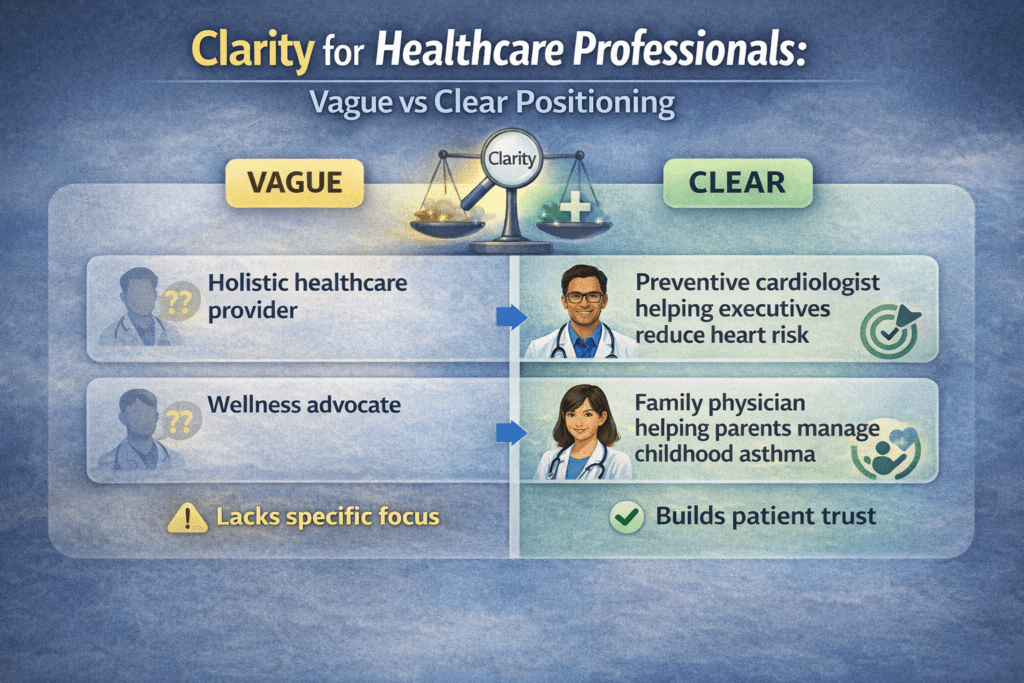
For example:
- “General practitioner helping people live healthier lives”
- “Wellness advocate”
- “Holistic healthcare provider”
These descriptions are positive but vague. They do not tell patients whether the provider is the right choice for their specific concern.
Patients are not simply looking for a good doctor.
They are looking for the right doctor for their situation.
Compare these two descriptions:
“Internal medicine physician”
and
“Preventive cardiology specialist helping professionals reduce heart disease risk early.”
The second description communicates far more clarity. It explains the problem being addressed, the type of care provided, and the patients most likely to benefit.
This is the value of clarity for healthcare professionals.
Clarity turns credentials into something patients can quickly understand and trust.
If credentials alone are not enough, the next question is why patients still hesitate. The answer lies in how people make decisions.
The Psychology of Decision Friction
To understand why clarity matters so much, it helps to examine how patients make healthcare decisions.
Healthcare decisions are rarely purely logical.
Patients often feel pain, fear, uncertainty, or anxiety when seeking medical help. Even routine concerns can feel stressful.
Because of this emotional context, people rarely analyze healthcare options in a perfectly rational way.
Instead, they rely on mental shortcuts to make decisions more quickly. Psychologists call these shortcuts heuristics.
One of the most powerful shortcuts is recognition.
When a patient encounters a provider whose expertise clearly matches their problem, the brain quickly responds:
“This doctor understands what I’m dealing with.”
This recognition reduces mental effort and increases confidence.
Confusion produces the opposite effect.
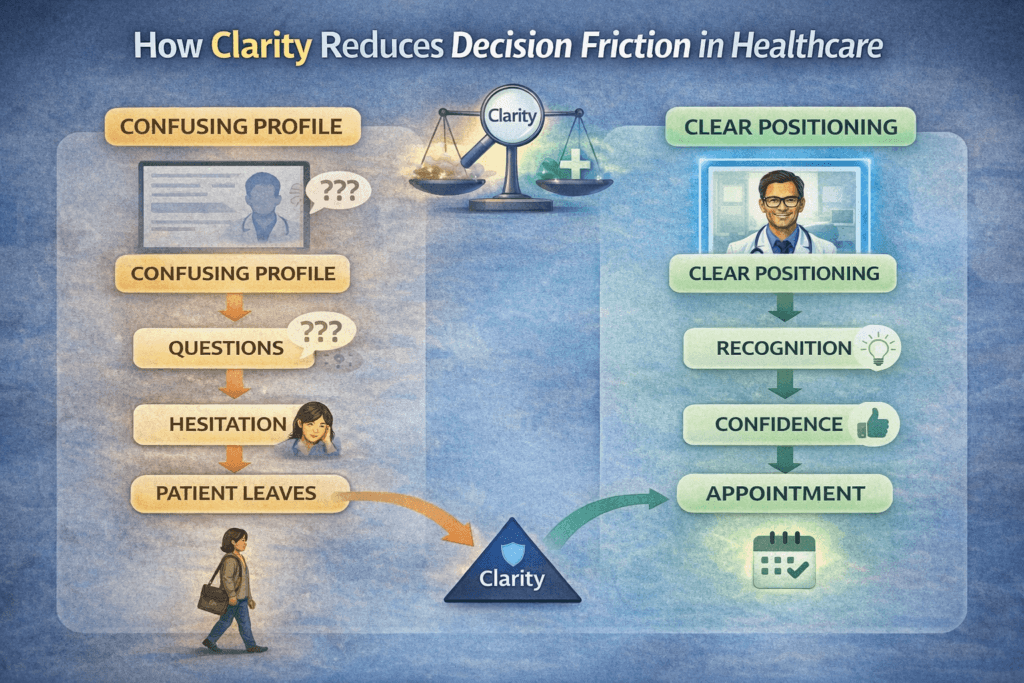
When patients must work hard to interpret a provider’s message, they experience what psychologists call decision friction.
Decision friction occurs when people must expend additional mental effort to understand their options.

For example, imagine a patient searching for help with chronic migraines.
They find a provider profile that says:
“Helping patients live healthier lives through integrative wellness.”
The statement sounds positive, but it is unclear.
The patient may begin asking:
- Does this provider treat migraines?
- Do they specialize in neurological issues?
- Do they treat adults or children?
Each unanswered question increases friction.
Friction leads to hesitation.
And hesitation often causes patients to continue searching.
Online, alternatives are only a click away.
This is why clarity for healthcare professionals acts as a trust accelerator.
When patients encounter a message that clearly explains the problem treated, the type of patient served, and the care approach used, decision-making becomes easier.
Recognition replaces confusion.
Confidence replaces hesitation.
And the likelihood of scheduling an appointment increases.
In many situations, patients are not choosing the most experienced provider.
They are choosing the provider who communicates the clearest connection to their problem.
Clarity does not replace expertise.
It helps patients recognize expertise.
The 4 Layer Clarity Model
The four layers work together to make a healthcare professional’s positioning immediately understandable to patients—especially in online environments where decisions happen quickly.
Clarity for healthcare professionals does not come from a single sentence or slogan.
Real clarity comes from a structured system that consistently explains what a professional does and why it matters.
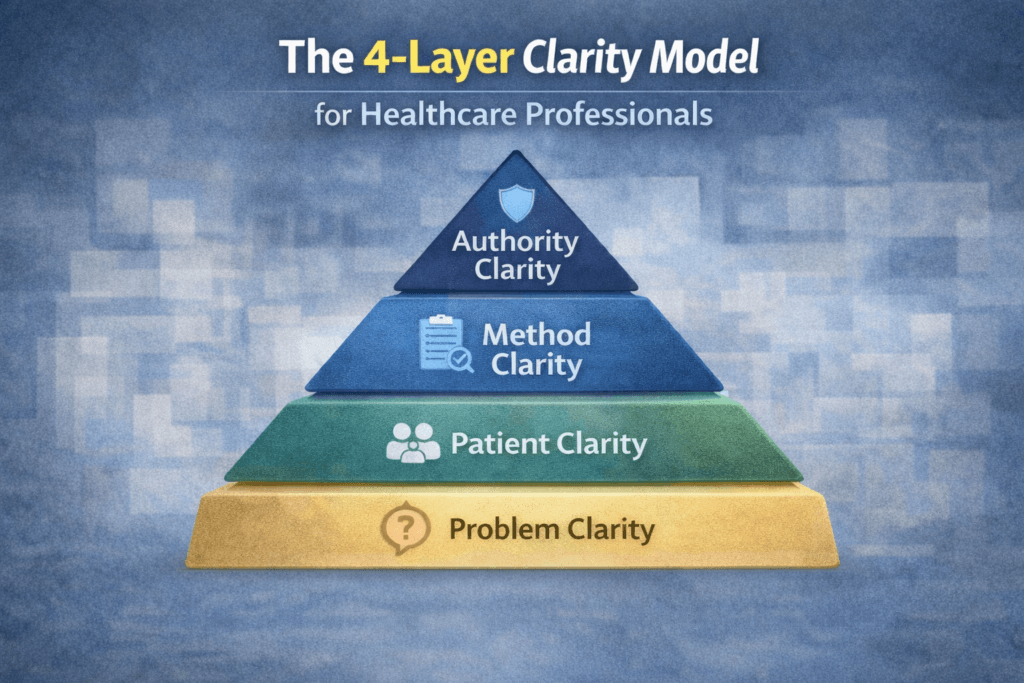
One effective framework is the 4‑Layer Clarity Model.
The four layers are:
- Problem clarity
- Patient clarity
- Method clarity
- Authority clarity
When these layers align, a healthcare professional’s message becomes much easier for patients to understand.
1. Problem Clarity
Problem clarity answers a simple question:
What problem do you help patients solve?
Many professionals simply describe their title.
For example:
“I am a dermatologist.”
While accurate, this statement does not explain the patient problem.
Problem clarity focuses on the condition or challenge patients experience.
Examples include:
- Helping patients manage chronic eczema and inflammatory skin conditions
- Helping professionals recover from burnout and fatigue
- Helping adults reduce metabolic risk before diabetes develops
When healthcare professionals speak directly about patient problems, patients feel understood.
Feeling understood is the first step toward trust.
2. Patient Clarity
The second layer explains who you help most.
Many professionals attempt to communicate that they treat everyone. While inclusive, this often weakens positioning.
Specificity strengthens clarity.
Examples include:
- Women experiencing hormonal imbalance
- Athletes recovering from sports injuries
- Busy professionals dealing with stress and fatigue
When patients see themselves reflected in the description, they feel recognized.
Recognition strengthens trust.
3. Method Clarity
Method clarity explains how the professional approaches care.
Different healthcare professionals may treat the same condition using different philosophies or treatment strategies.
Patients increasingly want to understand the approach behind the care they will receive.
Examples include:
- Evidence-based preventive medicine
- Integrative lifestyle medicine
- Functional rehabilitation focused on long-term recovery
Method clarity helps patients understand what their care experience may look like.
4. Authority Clarity
Authority clarity explains why patients should trust the professional.
Credentials, certifications, years of experience, research, and professional recognition all contribute to authority.
However, authority works best when it supports clear positioning.
Instead of presenting achievements without context, authority clarity connects expertise to patient outcomes.
Examples include:
- 15 years helping patients manage chronic hypertension
- Board‑certified vascular specialist
- Research contributor in metabolic health
Authority reassures patients that the professional is capable.
Clarity helps patients understand why that capability matters.
When all four layers align, patients do not need to interpret the message.
They immediately understand what the professional offers and whether the provider is right for them.
Why Structured Presence Beats Content Bursts
Many healthcare professionals attempt to increase visibility by producing more content.
They post health tips on social media.
They share awareness campaigns during health observance months.
They occasionally publish blog posts or educational videos.
Content can certainly be helpful.
However, content without clarity rarely builds long-term authority.
In fact, inconsistent content can make messaging more confusing.
For example, a physician might post about nutrition one week, mental health the next week, exercise tips the following week, and general wellness advice after that.
Each individual post may be useful.
But collectively, the overall message becomes unclear.
Patients may struggle to understand what the professional truly specializes in.
This is why clarity for healthcare professionals should come before content strategy.
Content should reinforce clarity—not attempt to create it.
A structured presence ensures that every platform communicates the same positioning.
This includes:
- Website messaging
- Professional bios
- Social media profiles
- Educational content themes
- Podcast appearances
- Media features
- Public speaking engagements
When these elements consistently reinforce the same positioning, authority compounds over time.
Patients begin to associate the professional with a specific area of expertise.
Recognition becomes reputation.
Reputation becomes trust.
Trust leads to referrals and long-term patient relationships.
Healthcare professionals who build a structured presence gain a meaningful advantage.
Each piece of content strengthens their authority.
Without clarity, content becomes noise.
With clarity, content builds authority.
The Strategic Advantage of Clarity
Clarity for healthcare professionals is not simply a marketing tactic.
It is a strategic advantage that shapes how patients perceive expertise.
Today, patients are surrounded by information.
As a result, attention is limited.
People naturally gravitate toward professionals who communicate clearly and confidently.
Clarity signals competence.
It demonstrates that a professional understands both their field and their patients.
It reduces uncertainty during the decision process.
Most importantly, it allows expertise to be recognized quickly.
Healthcare professionals who lack clarity often assume that greater visibility will eventually resolve their positioning challenges.
However, visibility without clarity often amplifies confusion.
More people may see the message.
But fewer truly understand it.
The professionals who consistently stand out are not always the loudest online.
They are the clearest.
They communicate their expertise in ways patients can immediately recognize.
They remove hesitation from the decision process.
And they turn their digital presence into a powerful trust-building asset.
Conclusion
At its core, clarity for healthcare professionals comes from aligning four key elements—problem clarity, patient clarity, method clarity, and authority clarity—so patients can quickly understand why you are the right professional to help them.
Healthcare is becoming more competitive every year.
More professionals are building online profiles, sharing insights, and publishing educational content.
In this environment, authority does not come from volume alone.
It comes from clarity.
Clarity for healthcare professionals transforms expertise into recognition.
It reduces hesitation in patients’ minds.
It builds trust even before the first appointment.
And it turns digital presence into a strategic asset rather than a collection of disconnected posts.
Professionals who invest in clarity create a strong foundation for everything they communicate.
Those who ignore clarity often work harder just to maintain visibility.
In a world filled with information, the professionals who stand out are the ones who communicate with a clear purpose.

Serious professionals build a structured presence.
References and Supporting Research
The ideas discussed in this article are supported by research on patient decision‑making, online healthcare behavior, and trust in digital health information.
- Fox, S., & Duggan, M. (2013). Health Online 2013. Pew Research Center. This study found that a large majority of adults search online for health information and often compare providers before making decisions.
https://www.pewresearch.org/internet/2013/01/15/health-online-2013/ - Emmert, M., Meier, F., Pisch, F., & Sander, U. (2013). Physician Choice Making and Characteristics Associated With Using Physician‑Rating Websites: Cross‑Sectional Study. Journal of Medical Internet Research. This research shows that patients frequently rely on online information and reviews when selecting healthcare providers.
https://www.jmir.org/2013/8/e187/ - Redelmeier, D. A., & Shafir, E. (1995). Medical Decision Making in Situations That Offer Multiple Alternatives. JAMA. The study demonstrates how too many complex choices can lead to indecision, highlighting the importance of clear information for patients.
https://jamanetwork.com/journals/jama/article-abstract/389650 - Lee, D., & Daunizeau, J. (2020). Choosing What We Like vs. Liking What We Choose: How Choice‑Induced Preference Change Might Actually Be Instrumental to Decision‑Making. PLOS Biology. Research like this helps explain how people simplify complex decisions using cognitive shortcuts.
https://journals.plos.org/plosbiology/article?id=10.1371/journal.pbio.3000718 - American Medical Association. Communicating with Patients. The AMA emphasizes clear communication and patient-centered messaging as key components of trust and effective healthcare delivery.
https://www.ama-assn.org
These sources support a central idea of this article: when patients encounter healthcare professionals online, clear positioning and understandable messaging significantly influence trust and decision-making.
See how your clinic appears to patients online — and start building digital trust today.
Book Your Free Online Presence Health Check
Your clinic’s online presence shapes how patients perceive your care.
Let’s review your website, social media, and digital visibility —
and identify how you can build stronger patient trust before year-end.